1. Past Attempts
In the post Without Tags, No One Can Recall You, I argued that in a homogeneous group the individual becomes background noise, while tags become effective information.
In the image below, it is hard for us to remember any particular person, yet very easy to find someone through the A, B, C, D, E tags.
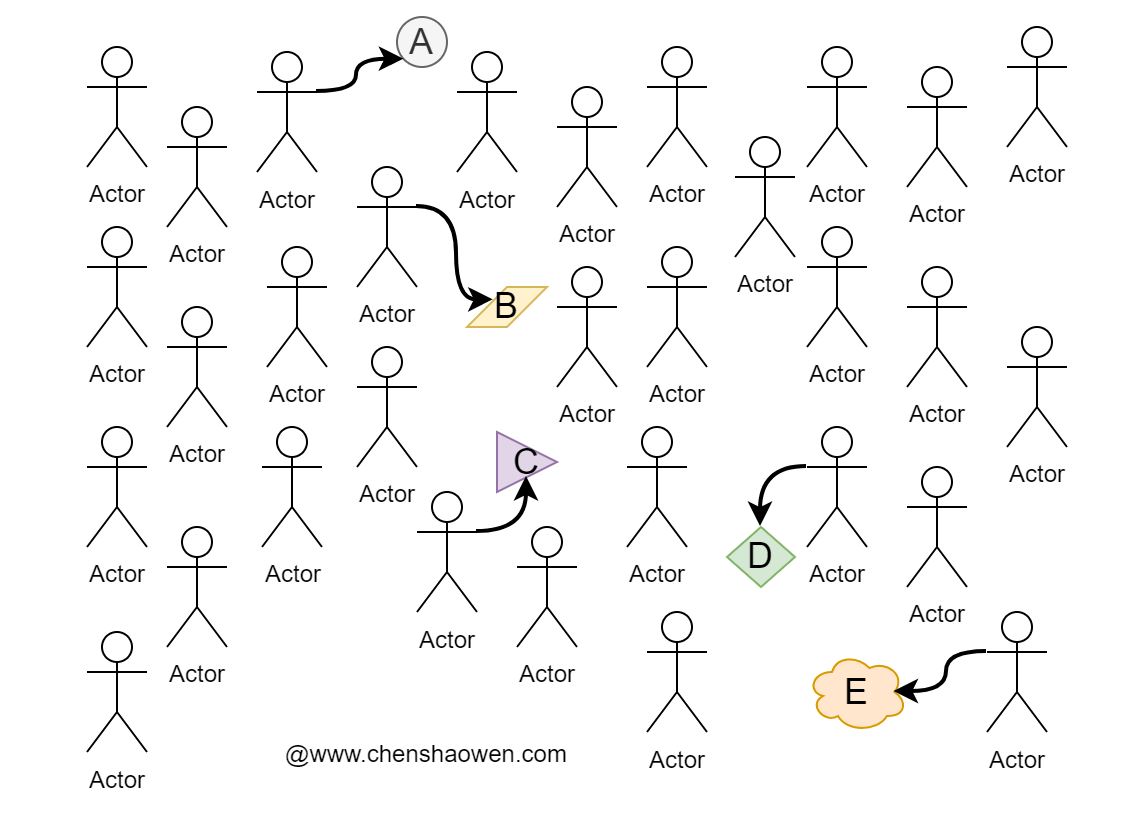
Once labeled, people form a network with one another, and all the tags together make up the characteristics of a group. These tags offer the possibility of further dividing the group.
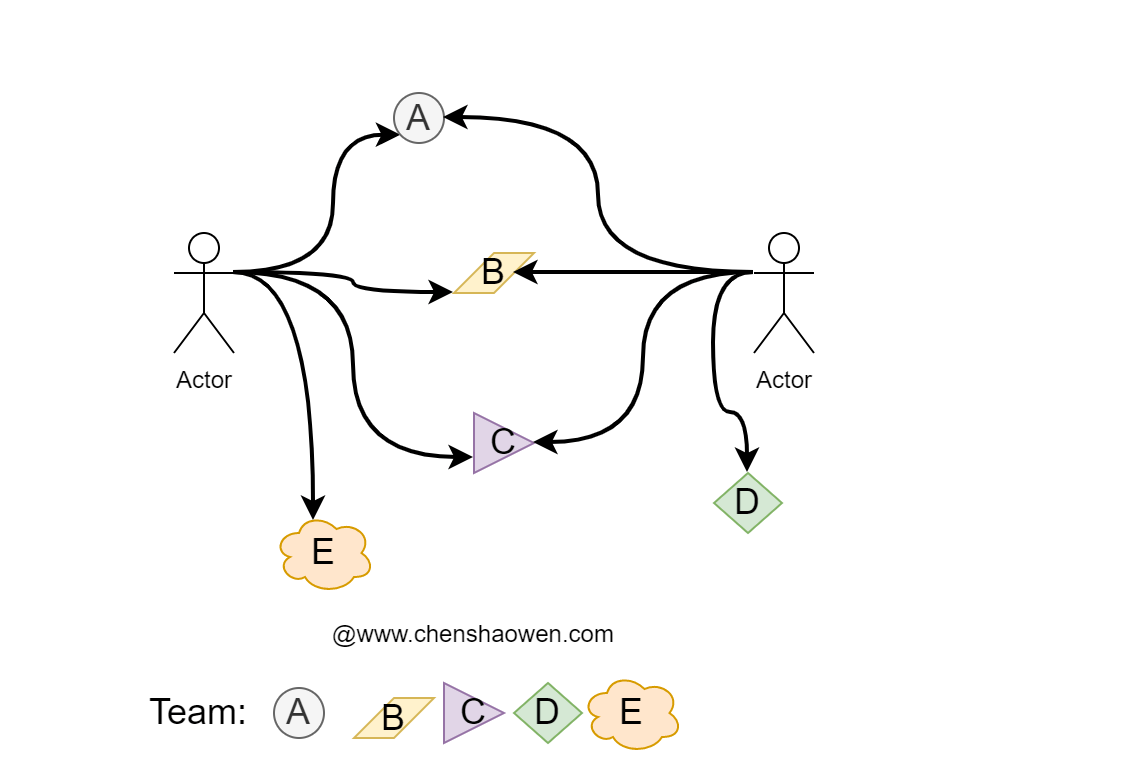
People who share more of the same tags cluster together, communicate at lower cost, and can better meet challenges. People with different tags complement one another, learn from each other’s strengths, and have stronger survivability.
In a previous team, with the leader’s support, I once asked members to enrich their own tags, to find more common ground with one another, and to blend the team better. At the same time, we divided study groups outside of work according to interest, tracked the latest technology trends, pushed each other to grow around specific topics, and organized sharing sessions on a per-group basis.
2. Sharing Matters So Much
In the post Building a Team of Consistency, I stressed keeping the level of understanding and the toolchain consistent in order to lower the cost of collaboration.
So how do you maintain that consistency? The answer is sharing.
Communication cost is the main obstacle to an organization growing larger. A matter for one person is decided by oneself; a matter for two people is decided through discussion; a matter for three is decided by vote. The more people involved, the longer the cycle to reach consensus and get things done, and opportunities are often missed.
In the post R&D Is Like Training Troops, Operations Is Like Deploying Them, I mentioned that the key to building an excellent team is establishing good mechanisms that give members a path to move toward excellence.
A mechanism of regular sharing, mutual exchange, and continuous learning, I think, should be among them.
Through sharing, knowledge within an organization can flow. Only when fresh water keeps welling up can a team stay vital. And for a software development team, I stress that a software product is the output of a team’s capability, and that a team’s domain capability is the core competitiveness of the product. Accumulating the team’s capability in a certain domain day by day, giving everyone on the team a path to grow, and turning individual skills into team skills — this is so important.
3. What Is Whiteboard Sharing
- It does not require much preparation
The common form of sharing is a PPT. Prepare the PPT, write good speaker notes, then find a time when everyone is free, book a meeting room, hold the clicker, and start sharing with a bit of unease in your heart. Formalistic, long-cycle, energy-consuming. The direct result is that sharing happens less often and fewer people take part.
- Emphasize communication over content
In the past, sharing focused more on content, demanding thorough research and authoritative material, which in fact hindered exchange. However deep or shallow one’s understanding, you should share the part you have grasped first. If there is a deviation, it can be corrected in time; if it is consistent, it can be reinforced. Either way, the team benefits.
Frequency x Quality = Benefit. Improving quality cannot happen overnight; it requires a great deal of accumulation, sustained investment, and broad collaboration. Frequency, however, is the key to mobilizing enthusiasm — as the number of sessions goes up, more people take part and become more active, and the content grows deeper.

So what does a whiteboard sharing session look like?
- One meeting-room whiteboard
- One sheet of A4 paper
- One web page
- One architecture diagram
- One mind map
- One slide of a PPT
- One analysis report
- One Word document
- …
As long as the sharer is comfortable, it can be long or short, more or less, online or offline, in a meeting room or at a desk — as long as it can explain one thing clearly and simply, it should be accepted. What we encourage is listing the key points and sketching the outline, not piling on excessive detail. Knowledge in the tech industry updates quickly, and practitioners usually have the ability to learn fast. I think what they want to gain is an overview of other domains and depth in their own. Through a single sheet of paper, being able to capture the key points of knowledge that would otherwise take days or even weeks to acquire is very appealing. And these points are usually close to the team’s working scenarios, making them more practical than content on WeChat official accounts or Weibo.
