1. What Is a Domain Name
1.1 The Composition of a Domain Name
The complete domain name of this site should look like this: www.chenshaowen.com.
Note the dot at the very end, which can usually be omitted. Reading a domain name from back to front, .com is the top-level domain, chenshaowen is the second-level domain, and www is the communication protocol.
A domain name can be made up of English letters, Arabic numerals, and the hyphen “-”, can be up to 67 characters long (including the suffix), and letter case makes no difference; each level can be at most 22 letters long.
1.2 Why Domain Names Exist
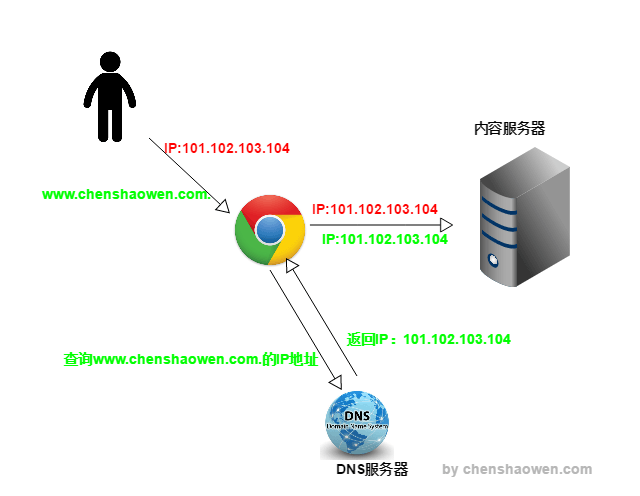
Take IPV4 as an example.
As shown in the red part of the figure, without using the Domain Name System, to visit a site a user has to enter an IP in the browser; the browser accesses the server holding the content according to the IP the user entered, and finally returns the page to the user. There are all kinds of sites on the internet, so a user would have to remember a great many IPs to access them directly, which is very inconvenient. Search engine technology appeared after the Domain Name System.
As shown in the green part of the figure, after using the Domain Name System, users no longer have to remember a lot of IP numbers. They simply open the browser, enter the domain name, and the browser queries the Domain Name System to obtain the host’s IP, then fetches the content from the host and returns it.
From the analysis above, we can see that domain names came into being to make it easier for users to access the content of a given website.
2. Domain Name Classification
Top-level domains fall into two major categories:
2.1 One Category Is Generic Top-Level Domains (gTLD)
.com : commercial organizations, businesses, companies
.gov : governmental entities, government departments
.net : network operations and service centers, network service providers
.org : other organizations, non-profit organizations
.edu : educational institutions, research and teaching institutions
.int : international organizations, international organizations
.mil : military (U.S.), the U.S. military, a domestic domain
.tv : TV stations or channels
.info : information networks and information services
.name: generally registered and used by individuals
.biz : stands for business
.name : stands for individuals
.pro stands for experts
2.2 The Other Category Is Country and Region Code Top-Level Domains (ccTLD)
.cn : China
.us : United States
.de : Germany
.jp : Japan
.cc : Cocos Islands, Cocos Islands
.co : Republic of Colombia
.in : India
3. The Value of a Domain Name
3.1 Brand Promotion
For commercial organizations, the most important use of a domain name is brand building. A good domain name is more important than a CTO. If a large multinational company’s homepage used a very casual domain name, it would give people a knockoff, unprofessional impression. Even in the app era, when a portal seems less important, a domain name that matches the commercial organization still reflects that organization’s strength and legitimacy very well.
3.2 Secure Access
As for domain suffixes, org, gov.cn, and edu.cn domains carry higher authority.
As for typos, it is important to avoid mistakes when users access the site directly. Google, for instance, has registered and enabled a large number of domains to avoid errors when typing google.com, such as googl.com, whereas Baidu has not — baid.com redirects to a for-sale page.
3.3 Saving on Promotion Costs
360buy.com, jingdong.com, jd.com — these are all JD.com’s domain names. You can clearly see that the domain names JD uses are becoming more and more recognizable, so that direct access simply cannot go wrong. That also saves part of the Baidu promotion budget.
4. How to Choose a Domain Name
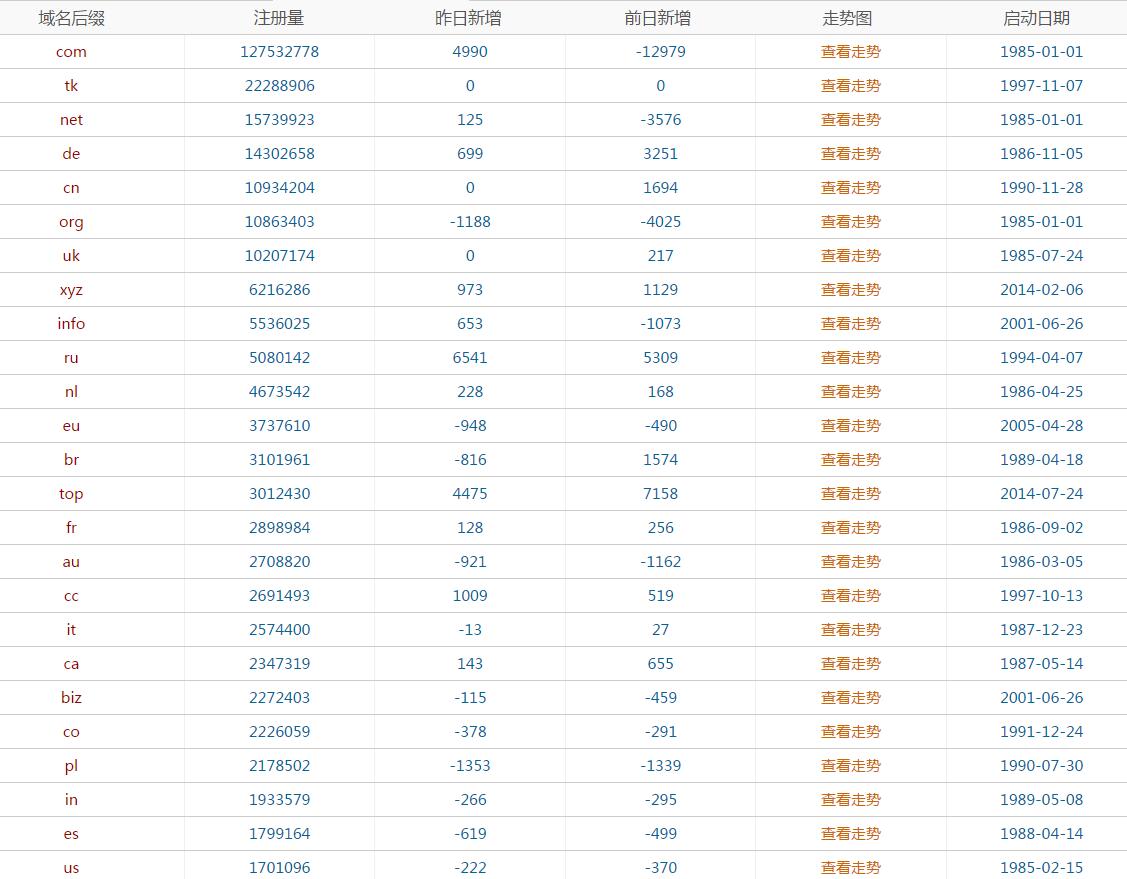
Screenshot date: August 11, 2016
Above are the registration stock and growth of various domain suffixes. .com was first used for commerce and has an influence no other domain can match. .tk adopts a free strategy. .net and .org are also relatively early generic domains.
Taking a company choosing a domain as an example, choosing a domain has two parts: the typo and the suffix. For an individual choosing a domain, whatever they like is fine.
The optimal suffix is .com. English and double-pinyin domains were registered long ago; companies with sufficient funds can buy them outright, and startups can try creative domains, but the optimal choice is still a .com domain — successes like ele.me are, after all, a minority. The .com domain is still the domain generally accepted by people.
If .com is already in your hands, you can also defensively register .cn, .com.cn, .org, .net, .cc, .co — the domains accepted in China — and of course you can also protect .biz, .xyz, .info and the like. Try not to register new-suffix domains; these domains do well at promotion, but they cannot withstand the test of time, and almost none of them will ultimately settle down.
For the typo part, the shorter and the more brand-foregrounding the better; use all-English, all-numeric, all-pinyin, and try not to use mixed domains such as v078.com. Always remember that a domain name’s value lies in: brand, security, and convenience. Without these, a domain name has no value. You can adopt the following registration strategies:
the company name’s pinyin or abbreviation, the company’s English name or abbreviation, company name + industry registration, or a creative domain.
The range of creative domains is very broad — using letter pronunciation (for example, “e” is pronounced “yi”), matching English pronunciation to Chinese, and so on.
The advice for startups is that having a double-pinyin domain is better, but if you don’t have one there is no need to spend too much to buy it — use a creative domain first and buy one once you have the funds. Premium domains will become more and more valuable, especially good brand double-pinyin ones; domain names have a certain financial character, are globally unique, and clearly exhibit scarcity. A startup should choose its domain name first, and only then go register the company, the trademark, and so on.
