Today’s enterprises run many lines of business and often need a large number of domains to support their growth. This article looks at four aspects — choosing enterprise domains, domains and brand building, site SEO, and site security — and asks how an enterprise should plan and build its own domain system.
1. A Few Words Up Front
A small company can leave the building of a domain portfolio aside for now; mid-size and large companies (50 people or more) should start giving it serious thought at their scale. A small company’s entire energy should go into a single line of business. For a registrar, prefer one with a long track record and a large scale — only with the registrar’s credibility is a registered domain dependable. If funds allow, MARKMONITOR INC is an option, at least for the main site’s domain. As for renewal, it is best to register for 5-10 years up front and then renew one year at a time after that. The same goes for projects whose future is uncertain: even if the project dies a year or two later, do not release the domain too early — keep holding it for a few more years so no one else can use it maliciously.
2. Business Considerations in Choosing Domains
The so-called main site is the site that best represents the company’s core business. For example, www.jd.com. A main site should grow gradually along with the company; built early and ranked high, it deserves the heaviest weight in domain planning. Once the company prepares to expand into other lines of business, it should begin preparing domain construction and reserving the relevant domains — .com/.cn/.net/.org should all be held in hand.
The business here falls into two categories:
- One is business with policy risk or special operating requirements
For the first category — bbs, finance, payments, and the like — running such business in China carries a certain risk of being shut down. An independent-domain strategy should be used: as with this site, bbscsw.com, cswbbs.com, chenshaowenbbs.com, cswpay.com, cswstock.com — even independent keywords are fine. But do not use a subdomain of the main site such as bbs.chenshaowen.com; if this kind of business violates regulations, the main site runs the risk of failing to resolve. - One is business that serves the main business
For this category — horizontal expansion, vertical depth, and so on — any business built on top of the existing industry can use the main domain to carry its traffic. The reasoning is as follows:- No need to register a separate domain for each business, saving money
- No need to be too constrained in choosing business names, saving time
- Good for the main site’s SEO
- Business may change, so it is easy to maintain
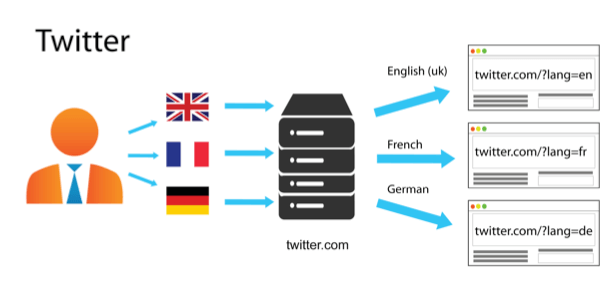
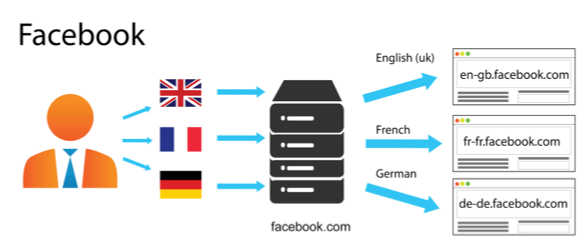
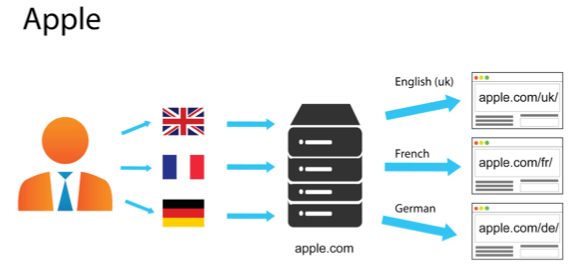
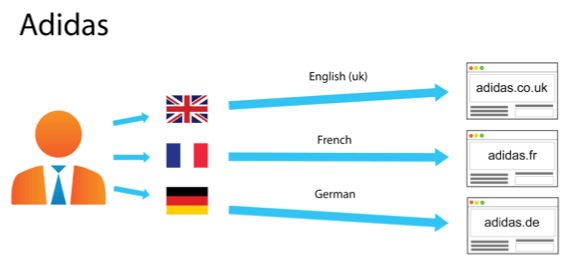
Below are four different approaches to cross-border deployment taken by twitter, facebook, apple, and adidas. The differences between versions have much in common with deploying different lines of business — except that one is about language and the other is about business.
3. Brand
A good domain is worth as much as a good CTO. That is no exaggeration — a domain of good quality can indeed let a company grow twice as fast with half the effort, bringing excellent word-of-mouth and enormous traffic. Think of baidu.com and taobao.com: the domain matches the brand, and after taking industry leadership the brand becomes synonymous with the industry. Once such an advantage forms, it is very hard for other companies to overtake it. At the very beginning of building a company, you should think through the consistency of domain, trade name, and trademark. If the domain you need is registered by someone else but no site has been built on it yet, you can contact the registrant to buy it. You can also entrust a third party to buy it, to avoid having no second chance after a failed deal. My thoughts on choosing domains are expressed in another post of mine.
4. SEO
Ten sites in the top 100 are worth less than one ranked first. The rule of the market is winner takes all; the top three divide most of the market share. Rather than attacking on many fronts, it is better to concentrate your force on one breakthrough. As mentioned above, business expansion without policy risk can be run directly under the main site via a subdomain, a subdirectory, or a submenu, so that the weight brought by the new business all gathers at the main site. Traffic between one business and another will also create a synergy, promoting each other.
5. Security
We are gradually entering an all-https era, and using https is of course mandatory. The security here refers more to the security of the site network as a whole. Once a company reaches a certain scale, it will isolate the intranet from the extranet to develop, test, and deploy systems. In that case, if a single enterprise site is breached, the entire site network may be threatened. So here are some suggestions:
- Use independent domains as little as possible; expose as few external access interfaces as you can
- Use an independent domain for a self-built CDN that supports the whole site network
- Do a good job of cookie isolation between subdomains
