1. Standard Libraries
The libraries that Robot Framework can import and use directly, found in the directory python\Lib\site-packages\robot\libraries. For details, see the documentation.
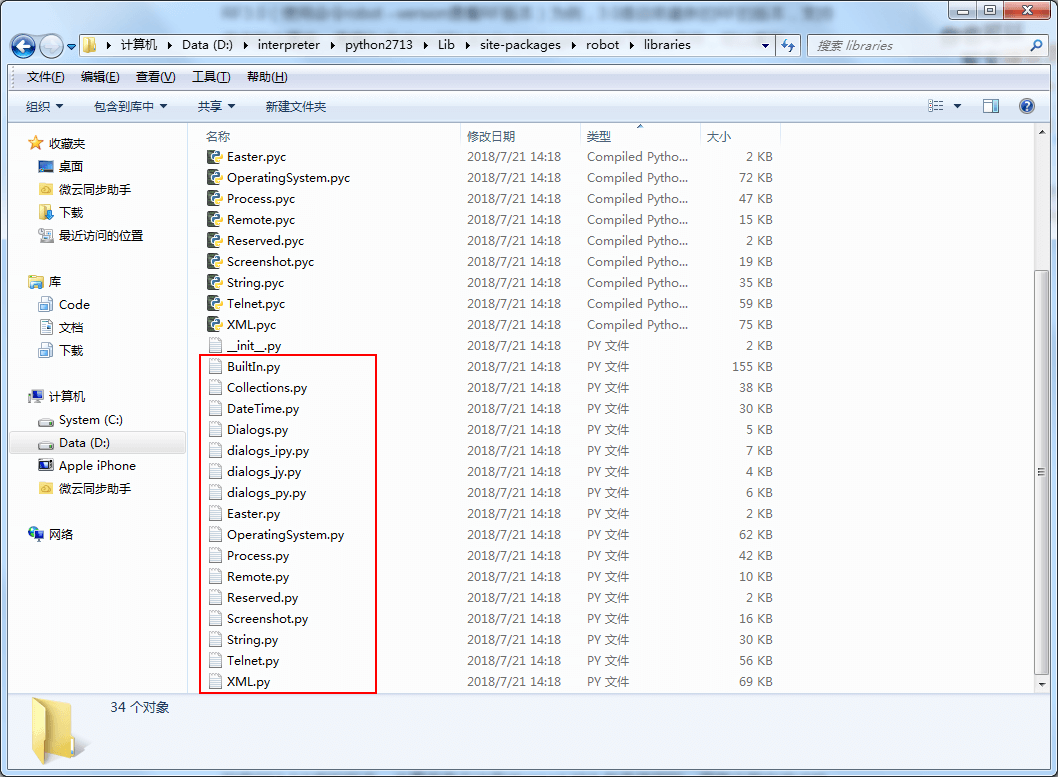
Builtin, contains the keywords that are needed most often. It is imported automatically without an import, so it is always available.
Dialogs, provides ways to pause test execution and to take input from the user.
Collections, provides a set of keywords for handling Python lists and dictionaries.
OperatingSystem, allows various operating-system-related tasks to be performed. Allows various operating-system-related tasks to be performed, so that the various operating-system-related tasks run on the system where Robot Framework is running.
Remote, part of the remote library interface. It has no keywords of its own; it is a special library acting as a proxy between Robot Framework and the test library. The actual test library can run on a different machine and can be implemented in any programming language that supports the XML-RPC protocol.
Screenshot, provides keywords to capture and store screenshots of the desktop.
String, a library for handling strings and verifying their content, used to generate, modify and verify strings.
Telnet, supports connecting to a Telnet server and executing commands over the open connection.
XML, a library for generating, modifying and verifying XML files.
Process, a library for running processes in the system.
DateTime, a library for date and time conversion, supporting the creation and verification of date and time values as well as calculations between them.
2. Extended Libraries
The libraries Robot Framework must download and install before use, as follows:
Android library, all the test libraries needed for Android automation; internally it uses Calabash Android.
iOS library, all the test libraries needed for iOS automation; internally it uses the Calabash iOS service
appiumlibrary, a test library for Android and iOS; internally it uses appium.
HTTP library (livetest), a library for HTTP testing that internally uses the LiveTest tool.
HTTP library (Requests), a library for HTTP testing that internally uses the request tool.
MongoDB library, a library for interacting with MongoDB using pymongo. (MongoDB is a database based on distributed file storage.)
Database Library (Java), a Java-based database test library. Jython and Maven central can also be used.
Database Library (Python), a Python-based database test library. Supports any Python interpreter, including Jython.
watir-robot, a web test library using the Watir tool.
seleniumlibrary, a web test library that internally uses the fairly popular selenium tool. It relies on the early selenium 1.0 and is itself already outdated.
selenium2library, a web test library using selenium2. It replaces most of the old seleniumlibrary.
selenium2library java, the Java interface of selenium2library
Django Library, a library for Django, a Python web framework.
sudslibrary, a functional test library for SOAP-based web services, a dynamic SOAP 1.1 client.
Archive library, a library for handling .zip and .tar archives.
Diff Library, a library for comparing two files.
FTP library, a library for testing and using FTP services on Robot Framework.
SSHLibrary, executes commands on a remote machine over an SSH connection. It also supports file transfer using SFTP
rammbock, a general network protocol test library; it provides a simple way to specify network packets and to check the results of packets sent and received.
imagehorizonlibrary, a cross-platform, image-recognition-based pure Python GUI automation library.
autoitlibrary, a Windows GUI test library, using the free AutoIt tool as the driver.
Eclipse Library, a library for testing Eclipse RCP applications using SWT widgets.
robotframework-faker, a library serving faker, the faker test data generator.
swinglibrary, a library for testing Java applications with Swing GUI
remoteswinglibrary, uses the swinglibrary library to test and connect to a Java process, especially a Java Web Start application. (Java Web Start is a deployment solution for applications based on Java technology; it is a convenient channel connecting a computer to the Internet, allowing users to run and manage applications completely independently of the Web)
MQTT library, a library for testing MQTT brokers and applications.
