1. What Is RAID
RAID technology combines multiple physical hard drives into a single logical hard drive, so the operating system sees it as one storage device.
There are two ways to implement RAID: hardware and software.
A hardware implementation is a RAID controller, a standalone hardware device responsible for RAID control and management.
A software implementation is RAID software, a program responsible for RAID control and management.
2. RAID 0
RAID 0 (also called a stripe set or striped volume) splits (“stripes”) data evenly across two or more disks.
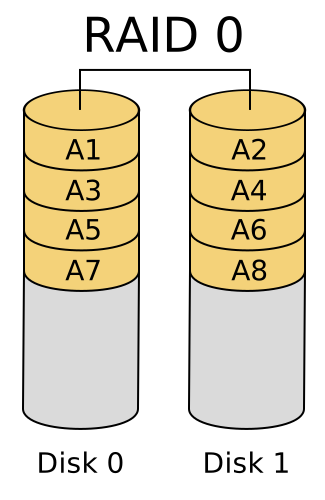
For a RAID 0 array made of n drives, the theoretical data read/write throughput is n times that of a single drive.
It suits applications that demand extremely high performance and can tolerate lower reliability, such as scientific computing or temporary file storage for games.
3. RAID 1
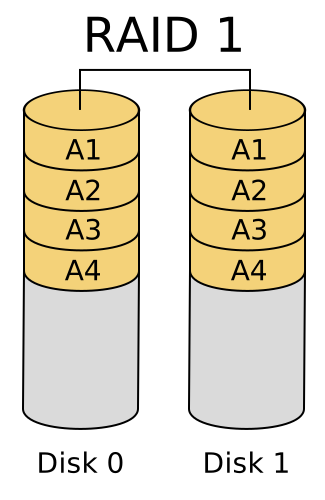
RAID 1 keeps an exact copy (or mirror) of a data set on two or more disks.
The data is identical on all member disks. The usable capacity of the array equals that of the smallest member disk.
4. RAID 5
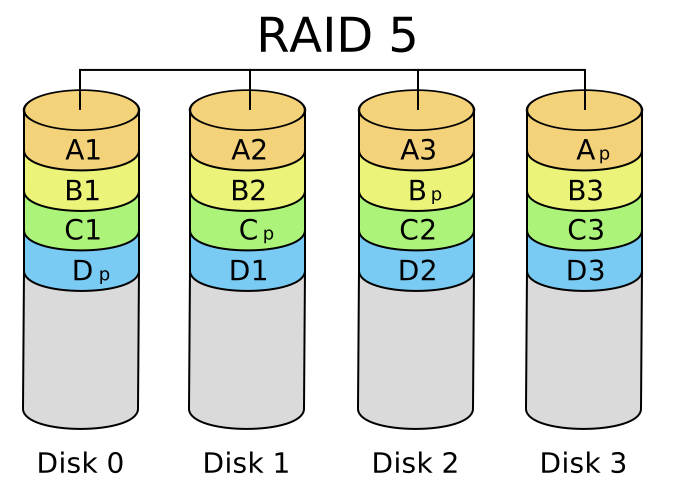
RAID 5 uses block-level striping with distributed parity, with the parity information interleaved across all member disks, thereby solving the write bottleneck of a single dedicated parity disk.
5. RAID 6
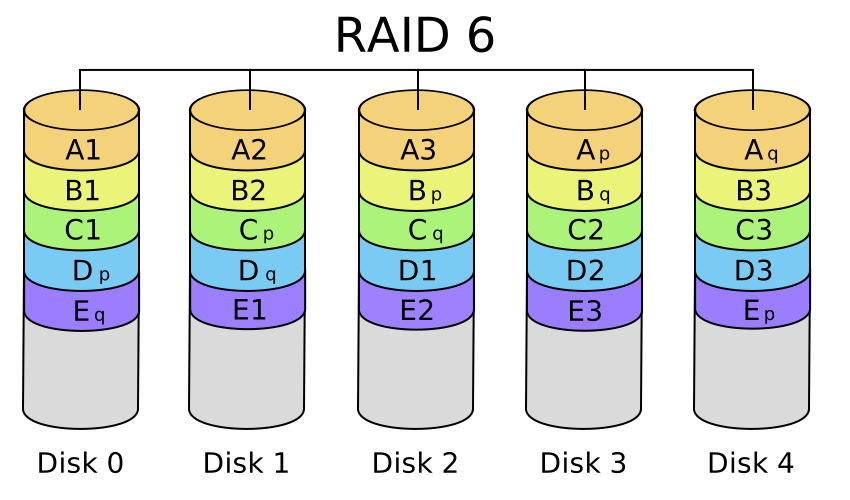
RAID 6 extends RAID 5 by adding a second independent parity block, thereby improving data reliability. The write performance of RAID 6 (especially random writes of small data blocks) is usually lower than that of RAID 5.
6. RAID Comparison
| RAID Level | Minimum Disks | Max Fault Tolerance (Disks) | Usable Capacity (n=disks, s=per-disk capacity) | Read Performance (Multiple) | Write Performance (Multiple) | Safety | Purpose |
|---|---|---|---|---|---|---|---|
| 0 | 2 | 0 | n×s | n | n | Low, one failure loses all data | Maximum capacity and speed |
| 1 | 2 | n-1 | s | n | 1 | High, works as long as one disk is healthy | Maximum safety |
| 5 | 3 | 1 | (n-1)×s | n-1 | n-1 | Medium, tolerates a single disk failure | Balance of capacity, performance, safety |
| 6 | 4 | 2 | (n-2)×s | n-2 | n-2 | Medium-high, tolerates two disk failures | Safer than RAID 5 |
| 10 (1+0) | 4 (even) | 1 per mirror group (n/2 groups total) | (n/2)×s | n | n/2 | High, each group needs at least one healthy disk | High performance and high safety |
| 50 (5+0) | 6 | 1 per RAID 5 subgroup | (n-k)×s (k=number of subgroups) | n-k | n-k | High, improves write performance and safety | Performance and safety for large arrays |
| 60 (6+0) | 8 | 2 per RAID 6 subgroup | (n-2k)×s (k=number of subgroups) | n-2k | n-2k | Very high, strong fault tolerance | Ultimate data protection for critical workloads |
