Adobe acquired Magento for $1.67 billion, Microsoft acquired GitHub for $7.5 billion, IBM acquired Red Hat for $34 billion — open source turns out to be a good business too. This article is mainly a record of, and some thoughts about, open source.
1. What Open Source Is
1.1 History
In 1969, Bell Labs shared the Unix source code with the community, laying an important foundation for open source.
In 1984, Richard Stallman left MIT and started the GNU project, hoping to build a Unix-like operating system from free code. After that, Stallman founded the Free Software Foundation (FSF), initiated the GNU General Public License (GNU GPL), and developed a series of important products such as GCC and Emacs.
In 1991, Linus Torvalds released the Linux operating system kernel under the GPL.
In 1995, Apache was born and quickly took most of the Web server market share.
In 2000, open source extended into mobile and cloud, driven by large companies such as Google, shaping technology roadmaps and the market landscape.
In 2008, code hosting platforms such as GitHub, collaborating through pull/request and the like, pushed open source to a new height.
In 2014, Google open-sourced Kubernetes, which drew enormous attention. After several years of development, Kubernetes became the de facto distributed architecture platform.
Alongside these events, a series of foundations were also established. Through mechanisms such as internal prioritization and funding, these foundations powerfully advanced the open source movement.
It is worth noting that free software and open source essentially refer to the same scope of programs. Their difference lies more in values.
1.2 Open Source Licenses
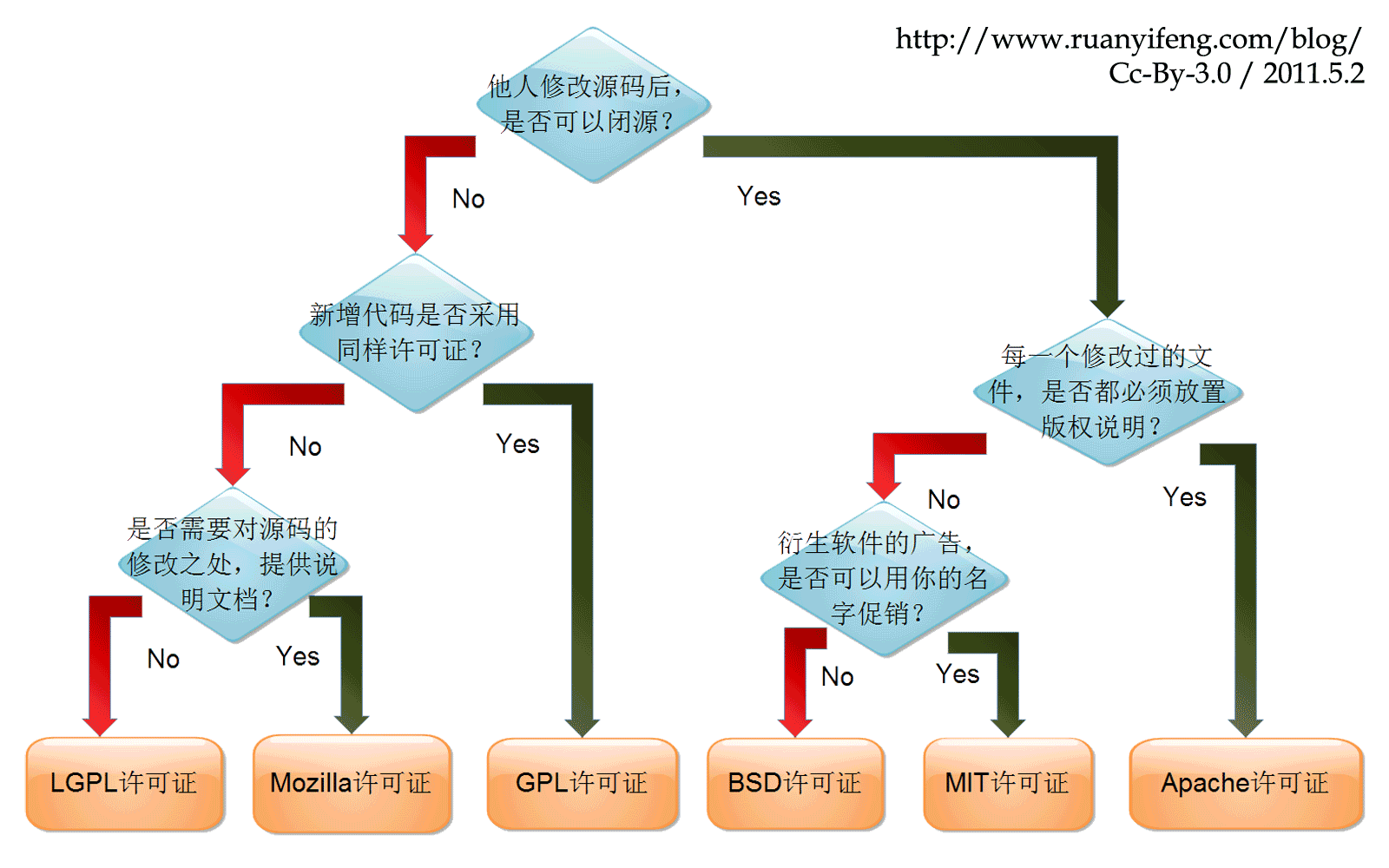
Open source licenses exist to protect the legitimate rights and interests of authors and contributors, ensuring an open source project is not stolen by a commercial organization or individual in a way that would harm the project’s development.
The diagram below gives a clear, concise explanation of the six mainstream open source licenses: GPL, BSD, MIT, Mozilla, Apache, and LGPL.
2. The Benefits Open Source Brings
2.1 Better Promotion
For salespeople, open source is a very favorable advantage, representing an open and advanced R&D philosophy and technology. For recruiters, open source helps attract better engineers.
In the community, an open source project draws more attention and discussion; it is an opportunity to promote the product and can raise the organization’s influence in the field.
Open-sourcing a project also strengthens users’ willingness to try it, with little risk. Users have almost no cost early on, and after using it deeply they can even modify the source code to customize it. Open source projects are transparent, trustworthy, and sustainable.
2.2 Better Development Practices
Generally, open source projects have higher code quality, more complete documentation, and lower risk of abandonment.
In the traditional development model, a project’s code is closed off inside the company and rarely seen by anyone. Once open-sourced, the project faces the whole community. Whether it is code or documentation, developers become more rigorous and responsible.
At the same time, open source means more people participating, which pushes internal staff to standardize the development process and produce output for the outside world. External developers who take part personally also develop a special attachment to the project, making them more willing to use and promote it.
2.3 Better for Integrating the Upstream and Downstream
Through open source, developers can also quickly obtain feedback from upstream and downstream, adjusting and improving the product, which helps with product iteration.
Open source also means starting to cultivate an ecosystem of upstream and downstream partners. If a project has no upstream support and no downstream use, then it has no vitality. Building a larger community of shared interests, expanding the project’s influence, and occupying the related field are the only ways to build a strong competitive advantage.
3. How Open Source Makes Money
Open source will not become the profit center itself; it needs other channels to subsidize it.
- Selling cloud services to subsidize open source
For users, deployment, maintenance, and upgrades are all costs. Convenient services create opportunities to charge. There are two common models: SaaS and IaaS. The SaaS model directly provides a remote service and charges by time and usage, for example Sentry. The IaaS model integrates services through a public cloud platform provider, selling IaaS resources.
- Releasing multiple versions
Open source only provides the source code of the core modules and cannot meet all enterprise needs. Custom development and feature-enhancement development become the points where you can charge. By releasing tiered products such as a Community Edition, Enterprise Edition, and Advanced Edition, the Community Edition serves as a testing ground that gradually guides users toward the paid versions.
- Operations services
What is truly valuable to an enterprise is the software while it is running, not the static code. Various operational scenarios, incident handling, and the endless stream of security vulnerabilities and patch solutions can all become points where you can charge.
- Training, certification, and licensing
Through related training, certification, and licensing, you can create profit points.
- Selling merchandise
Besides the invisible services, there is also visible merchandise. For example, selling plush toys, T-shirts, and souvenirs can also serve as one source of income.
- Being acquired. For an independent organization, being acquired by a giant is also a decent destination.
4. What Open Source Requires
Not every product is suited to open source; commercial open source is about the ecosystem. I have observed some commercial companies that open-sourced a project on GitHub and got a high star count. But they did not keep operating it — the code commits are concentrated in a six-month period several years ago. In my view, such a project has no need to be open-sourced.
A good commercial open source project should do these things well:
- A leading solution implementation
The right way to do open source is to propose an advanced solution in the field and complete the core implementation. Open source only adds icing on the cake; it does not provide help in time of need. Only when the project itself has value can it attract broad participation.
- Complete documentation
Documentation is an extremely important explanation of the project. Clear, detailed documentation helps others participate.
- A passion for spreading the word
The era when good wine needs no bush is over, and similar competing products keep emerging. If you do not actively promote and evangelize, a project can easily miss its window of opportunity and ultimately fail.
We should actively promote the project and communicate more with peers and users. While spreading the word, developers also get feedback and can optimize, forming a good reputation.
- Maintaining a core user group
When a project is not yet very successful, cultivating a good core user group is very important. A product only becomes excellent through constant polishing and iteration. In that process, you need not only to write code but also for users to take part. The core user group is the product’s first users and also the spreaders of the community’s reputation.
- Recording FQA
In the early stage, having developers face customers directly for QA helps the product iterate quickly. Once the product has been polished to be stable enough, we should record FQA. Recording common questions reduces the interruptions to developers, guides users into answering other users’ questions, and returns things to the community.
- Regular sharing
No industry loves sharing as much as IT does. In recent years, I have observed that all kinds of community events are increasing, and developers are starting to take part both online and offline.
Community events are opportunities to promote the product; if you have the resources and a certain amount of influence, you can also start events yourself. Continuously operating both online and offline, gathering users, and forming a circle are becoming more and more important.
- Ecosystem cooperation
In the end, open source competes on the ecosystem. The ecosystem also brings open source organizations more possibilities for monetization. Ecosystem building should be done around the idea of win-win cooperation — for example, a platform vendor provides the platform and builds an app marketplace, app vendors develop applications and sell them on the platform to make money, and the platform becomes more competitive because of those applications.
