For more techniques, keep an eye on the updates to this post.
1. Operations Is No Longer Guesswork
Everything is interconnected, and the internet’s model of the physical world is becoming more and more accurate. Our geographic location, our movement trajectories, and our operations on electronic devices are all being recorded. If the user profiles of the major vendors could be pooled together, our digital version would emerge.
You can only represent the you of this moment, whereas your digital persona can represent the you of the past, the present, and even the future. Once data is generated, it is very hard to erase it completely from the internet, and the data person has a more complete description.
Compared with the stability of a program, a person’s advantage comes from uncertainty, and that is where innovation and new perspectives come from. But if this divergence is left unchecked, such creativity is hard to converge into a powerful driving force. So we need to think within a given scenario, grounded in a certain data foundation and theoretical basis.
Today’s internet gives us plenty of data to analyze. Operations can no longer rely on personal intuition; it has to use various user-growth tools and make decisions through quantitative analysis.
2. Fine-Grained Operations Means Understanding User Behavior
It is very hard to give equal weight to operations and R&D. In R&D Is Like Training Troops, Operations Is Like Deploying Them, I noted that the key to R&D is systems and processes, while the key to operations is riding the momentum. You cannot very well train troops and go out to fight a war at the same time.
In reality, a team’s energy and time are very limited, and different stages call for different emphases. In a project’s early stage, R&D matters more — lay a solid foundation early on. In the growth stage, operations matter more — spread out small-scale experiments, respond actively to feedback, and take good care of the user base. In the mature stage, large-scale practice exposes many problems, and you need to return to R&D once again.
Once you enter the growth stage, you should pay attention to operations and learn more about user behavior — where they come from, what they do here, and where they are headed.
Even a redirect link can be put to work; what matters is the awareness of data-driven operations and a habit of learning more about user behavior. For example, www.chenshaowen.com could redirect to www.chenshaowen.com?from=blog rather than www.chenshaowen.com — the same address, just with one extra GET parameter, and we can learn much more.
Someone who does not understand how the internet works cannot do operations well. Thousands upon thousands of servers run the various websites we visit every day, yet the basic communication protocols and access principles stay consistent — and that is precisely why the internet can keep expanding its boundaries: they share a common foundation. If you work in the internet industry, you must keep deepening your understanding of it.
Fine-grained operations means constantly splitting things apart and refining them: how our product reaches users, and how users use the product. From the very first document link, to a product trial, then payment, and finally long-term use — every step can be scrutinized and refined.
3. The Magic of Short Links
Common data-analytics tools — Google Analytics, or the newer generation such as GrowingIO — focus more on on-site behavioral data, while their data on traffic sources is not fine-grained enough.

Imagine a campaign QR code: which traffic-driving website to choose, what category to put the post in, what time slot to push it at, and so on — all these details can be scrutinized. But which approach is better is impossible to judge.
Short links can solve this problem. Through a short link, an intermediate layer is added between the user and the campaign landing page, enabling statistical analysis of more fine-grained traffic behavior.
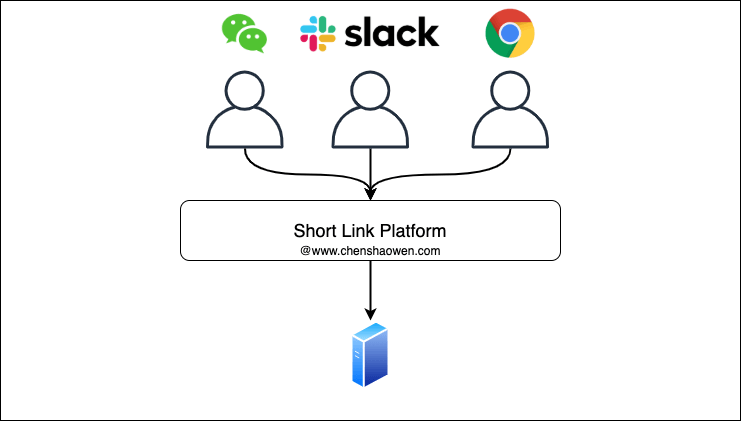
User visit ->
    -> Site A -> position AA -> short_url_1
    -> Site A -> position AB -> short_url_2
    -> Site B -> position A  -> short_url_3
    -> Site C -> position A  -> short_url_4
                                  -> QR code landing page
That way, through experimentation, we can arrive at an operational guideline.
4. Download Links Can Be Leveraged Too
After many internet conferences, the organizers provide the slide decks for download, so that people who could not attend or who want to dig into the details can look them over. Organizers are usually happy to distribute these decks too — one more distribution is one more round of publicity.
The common approach is to upload them to Baidu Cloud Drive and provide a share link. Well, contact is lost again. Who downloaded the slides? We have no idea.
Besides using the short links mentioned above, another approach is to use object storage. Many object storage services today have enhanced their statistics and analysis of download-side data. In object storage we can obtain the Remote IP, Time, User-Agent, Referer, and so on. These are analytical data points that Baidu Cloud Drive cannot provide.
