1. Three dimensions
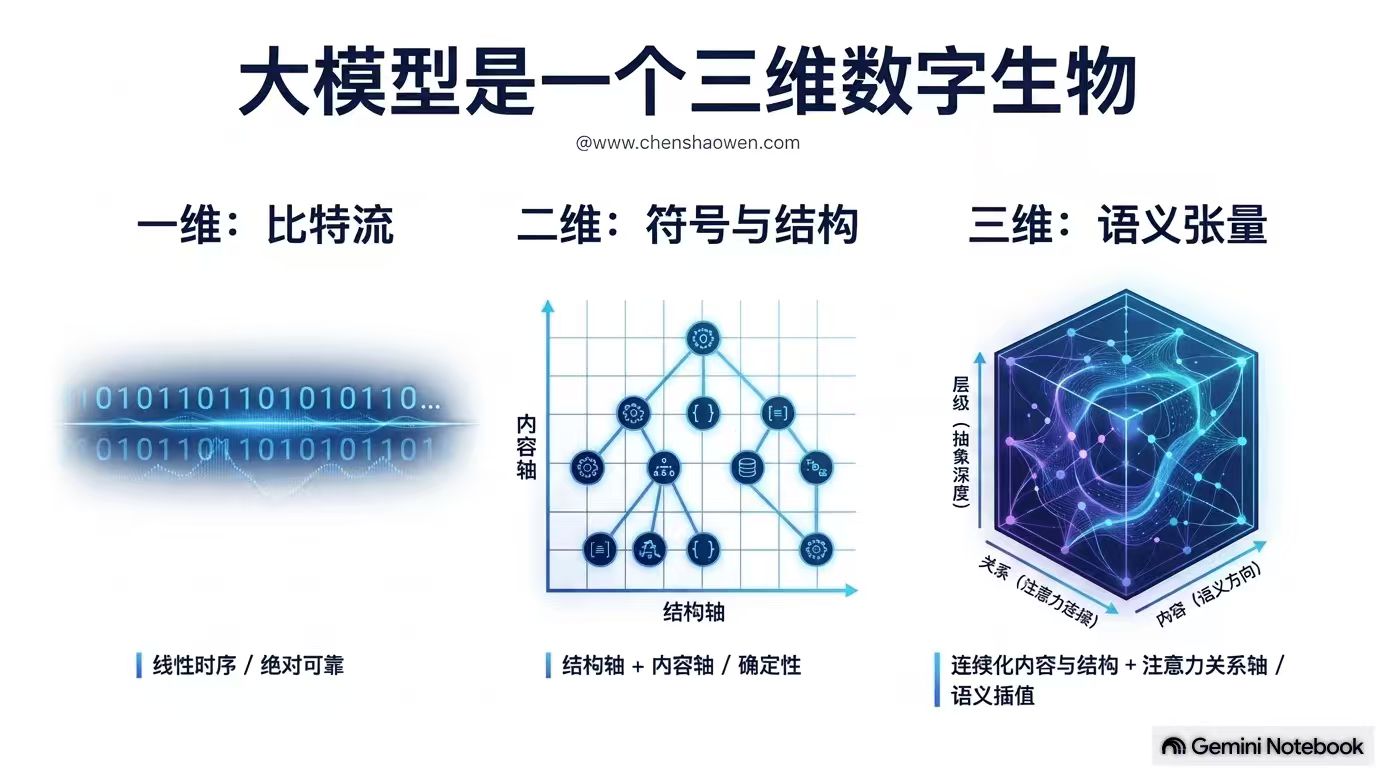
1.1 One dimension: a bit stream
| |
- Degrees of freedom: 1. There is only one direction — position. Everything has to queue up.
- Limitation: no simultaneity. Structure can only be flattened into an ordered sequence of events.
- Strength: reliable. It executes, nothing more.
1.2 Two dimensions: adding a content axis on top of the bit stream
The bit stream does not change. Only the way we read it changes: we cut the continuous bits into symbols. The position axis is still there, but it has been re-labelled from “which bit” to “which node of the structural tree”. The extra axis is what the symbol is.
| |
- Degrees of freedom: 1 + 1. The position axis is upgraded into a structural axis, and a content axis is added. The two vary independently.
- Limitation: it can only generalise to combinations that humans already wrote down.
- Strength: determinism. Testable, reproducible, and able to freeze intent into named artefacts.
1.3 Three dimensions: adding a relation axis on top of symbols
The symbols are still there, but no longer with one fixed meaning each. They enter a continuous space: content becomes a direction, structure becomes a hierarchy, and both take continuous values. A further layer appears between symbols — who should attend to whom.
| |
- Degrees of freedom: 2 + 1. Content is the continuous version of the 2-D content axis, hierarchy is the continuous version of the 2-D structural axis, and an attention/relation axis is added.
- Limitation: probability only. Hallucination cannot be removed.
- Strength: interpolate along semantic space, so inputs never seen before still get a nearby answer. Composition happens through context rather than encapsulation, which is why Context Window, RAG and MCP are primitives here.
1.4 Comparison
| Item | 1-D | 2-D | 3-D |
|---|---|---|---|
| Degrees of freedom | position | position → structure, content added | content and structure made continuous, relation added |
| Limitation | no simultaneity, cannot generalise | stops at human-written combinations | probability only, hallucination remains |
| Strength | absolutely reliable | deterministic, verifiable | interpolation by meaning |
2. Moving between dimensions
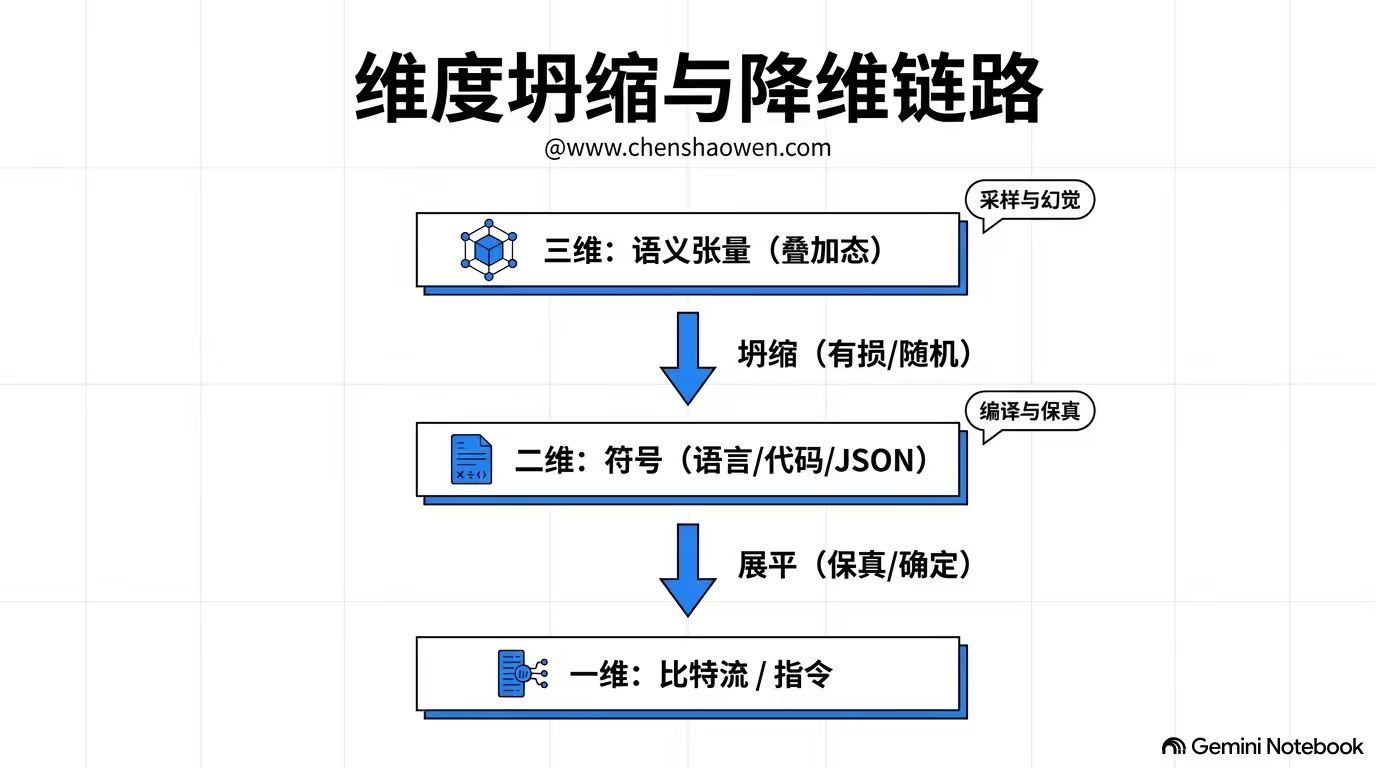
The dimensions only go downward: output is dimension reduction.
| |
2.1 3-D → 2-D: collapse, lossy
In weight space a concept is a distribution with no hard boundary. Cat is close to canines, close to tigers, close to cuteness. Only when the next token must be emitted is the distribution forced into a single symbol.
- The same question giving different answers is not a bug. It is collapsing into different eigenstates, all of them legal.
- temperature is the randomness knob. Zero forces the mode, and the mode is not the truth either.
- Every emitted token is one collapse.
2.2 2-D → 1-D: flattening, lossless
A compiler flattens a code tree into linear instructions. Function boundaries and types are compressed into jumps, but the structural information is fully encoded in the jumps themselves, which is why decompilation can reconstruct it — just less prettily.
Change the representation and the meaning survives; what is lost is the concrete shape of the structure.
2.3 The key difference: does the source dimension have a grammar?
Both are dimension reductions, one lossless and one lossy. The difference is not the target, it is the source:
- The 2-D layer has a grammar. Code is bound by a grammar; the shape of each fragment is fixed, so flattening is exact and reversible.
- The 3-D layer has no grammar. There is only a probability distribution; nothing states which symbol a piece of meaning must become, so collapse is necessarily lossy.
Which is why 2-D → 1-D is called compiling, while 3-D → 2-D can only be called sampling.
The most practical consequence: the only way to make 3-D → 2-D more faithful is to impose a grammar on the output. Constrained decoding, type systems and JSON Schema are all temporary grammars borrowed for the 3-D layer.
This loss has a name: hallucination. It is not a defect to be fixed but the price of collapsing at all — eliminating hallucination means demanding lossless collapse, which means demanding that the 3-D layer has a definite grammar, a contradiction. So the goal is not elimination but pricing: make each loss cheap enough to absorb. Multi-sample voting, external tests, sandboxes and human-in-the-loop are all doing exactly that one thing.
3. Closing
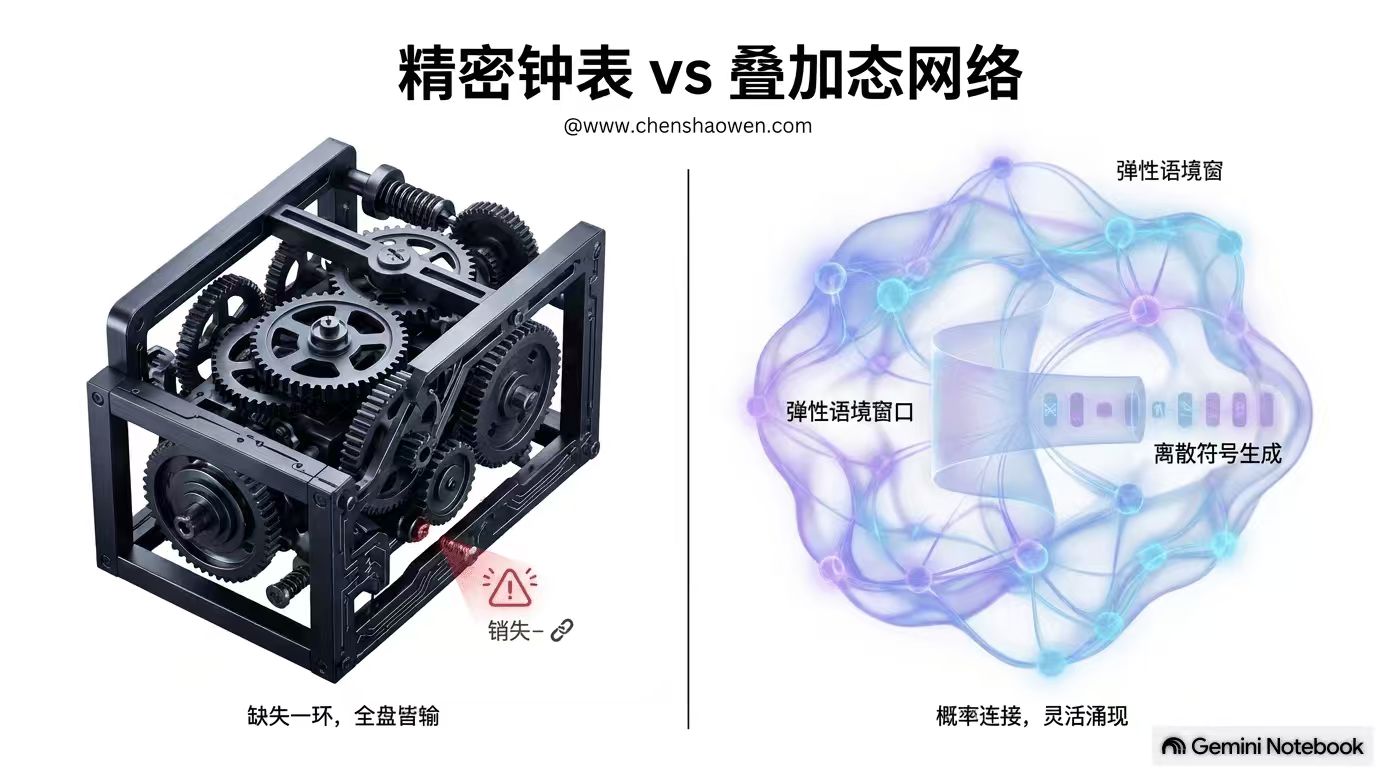
2-D code is like a precision watch: gears interlock, one missing screw stops everything. The 3-D model is the opposite — a ball of superposition inside, collapse on the outside.
Facing a human it collapses into natural language, where vagueness and blanks are part of the communication. Facing a machine it collapses into code, JSON and tool calls, where one misplaced bracket means failure. The same ball of meaning tolerates very different error rates depending on who is listening.
So for engineers there are really two kinds of work.
One is making it talk better: bigger models, better data, better decoding, pushing the distribution to be sharper. That work is real, but its ceiling is the density of the semantic space itself, and you cannot verify that it landed where you think. Poetry, novels and essays live here.
The other is making what it says checkable: grammar constraints, types, tests, sandboxes, human confirmation. That work buys no extra accuracy, but it buys visibility when things go wrong — verifiable, cumulative, and handoverable. Code, protocols and money transfers live here.
