1. User Scenarios for Hybrid Cloud
1.1 Handling Explosive Business Growth
Internet businesses grow exponentially, and it is hard to predict how much infrastructure capacity to reserve. Usually, for a long stretch in the early days of a business, a small colocation footprint of physical machines is enough to meet demand. But as the market opens up and the business scales explosively, the original colocation data center has limited rack space, and a public cloud becomes the only elastic option for rapid deployment and expansion to meet business demand.
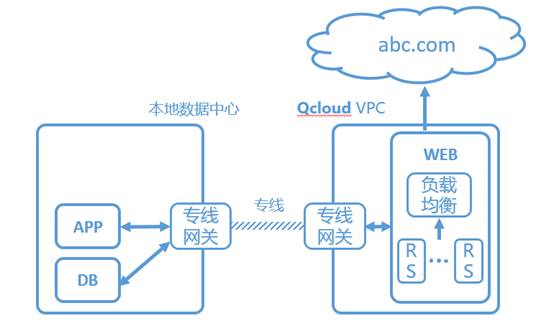
To save time, most of these users quickly set up an IPsec VPN connection to hold up under the traffic, then switch to a dedicated line once it is in place to provide a reliable hybrid cloud connection. After fully recognizing the stability and low cost of the public cloud, most of these users migrate everything to the public cloud once their original colocation data center contract expires.
1.2 Deploying a High-Availability Architecture for Multi-Site Disaster Recovery
These users are usually already very large in scale, and their core concerns are stability and reliability. They seek to evolve from a single center toward multiple centers, eliminating single points of failure to address the business risk that a single data center outage would bring.
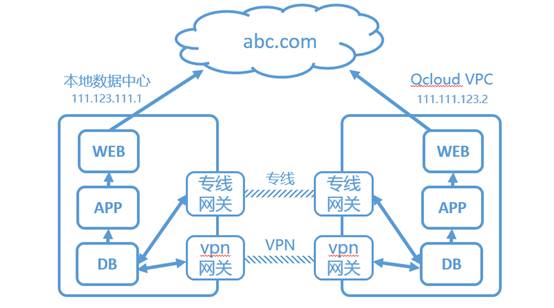
Common approaches to multi-site disaster recovery include same-city disaster recovery, cross-site active-active, and two sites with three centers. In the diagram, the local data center and the public cloud are deployed in different locations, and databases are mutually replicated as master and slave over a dedicated line; when a single center fails, traffic is switched to a healthy center, providing lossy but uninterrupted basic business services. For industries such as finance that demand high reliability and stringent requirements, a two-site approach can achieve lossless disaster recovery service.
1.3 Hybrid Cloud Deployment Under Regulatory Requirements
These users are typically in banking, finance, insurance, and similar industries that need regulatory compliance. Ordinary public cloud service infrastructure struggles to meet financial compliance requirements, so they tend to put the system’s Web tier, business market data, and enterprise OA in the public cloud, while placing core concerns such as rapid deployment, trading, and transaction records in compliant data centers.
2 Difficulties of Hybrid Cloud Technology
2.1 The Ability to Define Custom Networks on the Public Cloud
Custom networks here broadly refer to the likes of virtual private clouds (VPCs): the ability for users to define their own logically isolated private networks, including the basic capabilities of dividing subnets, configuring routes, and setting up public networks and gateways.
2.2 Diverse and Stable Network Access Capabilities
The most prominent feature of a hybrid cloud is connectivity, and there are mainly two access methods: public network access and dedicated line access.
To protect user information security, public network traffic on the Internet must be encrypted with IPsec VPN. Small gateways (below 200 Mbps) can generally be implemented with a virtual software gateway, while medium to large gateways (300 Mbps and above) can be implemented with hardware gateway devices. Public network access is very fast, typically deployable and usable within half a day, meeting customer needs quickly. Given the complex domestic network environment, congestion in some network topologies leads to increased network latency and packet loss, so enterprises are not advised to adopt VPN access above 200 Mbps; there are exceptions, however, such as when the user’s data center side cannot meet the conditions for a dedicated line and has no choice but to rely on high capacity to provide service.
Dedicated line access guarantees user data encryption and available bandwidth at all times and in all directions. Users need not worry about capacity being too large to carry, but dedicated line access has a long provisioning cycle and a higher price.
2.3 Security and Monitoring
A hybrid cloud connects a private cloud and a public cloud at the network level. If a network fault or attack occurs, the service provider must be able to ensure that faults between networks do not affect each other, confining the attack or fault within a certain scope.
2.4 Comprehensive API Management Support
After hybrid cloud deployment at scale, users can use APIs to quickly build an operations management system compatible with the public cloud on top of their existing local data center operations management system. Here the public cloud vendor only needs to provide atomic APIs, making it easy for users to use these modules to build elastic scaling systems, devise network backup plans, and so on.
3. Comparing Public Cloud, Private Cloud, and Hybrid Cloud
A hybrid cloud leverages the automatic, rapid elasticity of the public cloud as well as the private cloud’s tight control over sensitive business, performing well on all three fronts: security, cost, and service capability.
3.1 Advantages of Public Cloud
- Lower cost — no need to buy hardware or software; you pay only for the services you use.
- No maintenance required — maintenance is provided by the service provider.
- Nearly unlimited scalability — on-demand resources that can meet business needs.
- High reliability — a large number of servers provides protection from failures.
3.2 Advantages of Private Cloud
- Greater flexibility — an organization can customize its cloud environment to meet specific business needs.
- Greater security — resources are not shared with other organizations, enabling a higher level of control and security.
- Greater scalability — a private cloud still has the scalability and efficiency of a public cloud.
3.3 Advantages of Hybrid Cloud
- Control — an organization can maintain private infrastructure for sensitive assets.
- Flexibility — it can draw on other resources in the public cloud when needed.
- Cost effectiveness — with the ability to scale out to the public cloud, it can pay for extra computing power only when needed.
- Easy and effortless — no time or effort is needed to move to the cloud, because workloads can be migrated gradually according to timing.
