1. Drawing the Heavy Sword, Challenging the World
Since 1840, China endured more than a century of humiliation; yet starting in 1978, it took only a little over forty years to turn from a poor and weak great power into a wealthy and strong one.
This is a manifestation of a nation’s resilience and wisdom. A long cultural history provides people with ample nourishment. At the micro level, people can find a place for their own lives; at the macro level, it drives the development of the country and the nation.
The rise of the Chinese nation has already become an established trend. As that rising momentum pushes forward, no small stumble will change the direction of the great ship. But the rise of a nation is bound to change the global order and redistribute interests. This will also be the focus of contention over the next decade.
COVID-19 only ignited latent emotions and competition; the risks have never been removed. I believe that over the next decade, many countries will have all kinds of conflicts with one another, but they will also rebuild cooperation. Old cooperation frameworks will be overturned and new communities of interest built.
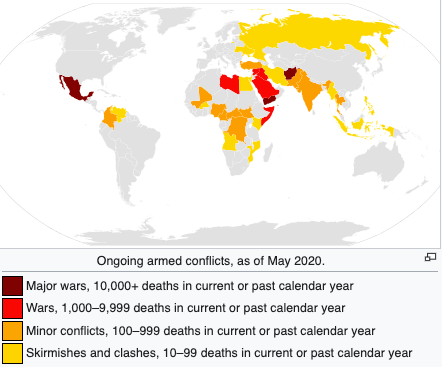
As shown in the image above, on wikipedia you can see that in recent decades many parts of the world have seen armed conflicts in which many people died. China, accustomed to peaceful development, will also gradually merge into a turbulent world, and play its own role within it.
2. Economy and Technology: Worlds Apart
The Chinese nation is a highly intelligent nation — this has been proven once again. Once it figures out the rules, it can quickly take a leading position. There is a great deal of empirical research on economic growth, so I will not copy and paste it here. Below is the GDP data I queried on WolframAlpha:
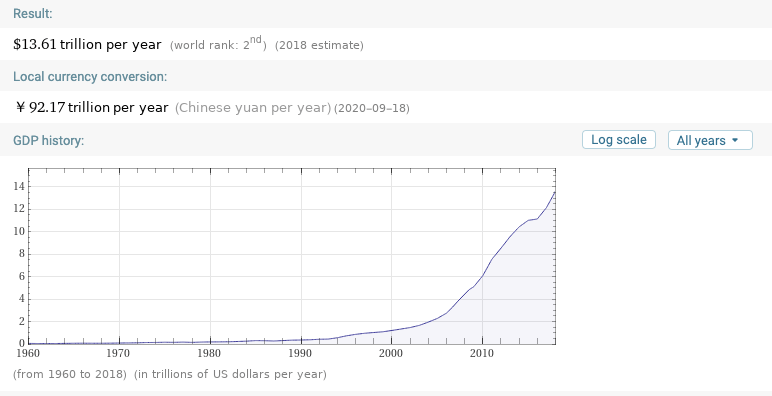
The data runs through 2018; growth has begun to slow over the past two years. China’s absolute GDP is already very large, and growth of around 10% a year is unsustainable — a flattening of the curve is inevitable.
Over the past decades, economic growth benefited from reform and opening up. China’s market is big enough and its working-age population large enough that as long as the restraints were loosened and people were allowed to go do things, they could always find some way to make money. Being able to endure hardship and being bold created one wave after another of people who got rich first.
As the market vacuum is gradually filled, what we face is an era of stock-based competition. In stock competition, the most important things are capital and technology. Take the internet industry I work in: Tencent dislikes holding controlling stakes and is good at equity partnerships, and it has a hand in more than half of the internet landscape, while the other half belongs to Alibaba. Alibaba likes controlling stakes — it buys the companies it likes, and if it cannot buy them, it builds its own. The basic environment of China’s internet is constituted by these two companies; no internet activity can fully escape them, and they occupy a monopoly position in both capital and technology.
At the recent Apsara Conference, Alibaba launched a cloud computer and a logistics robot. I wondered: are not many companies already doing this? Alibaba is so capable, why not do something more meaningful? Perhaps they have many considerations of their own; once a company gets big it has many problems, and it can also have an adverse impact on the whole industry ecosystem.
We are now on the eve of high-quality technological development. Data on the government website shows that in 2018, Asia accounted for two-thirds of the world’s patent applications, and China alone accounted for nearly half of the world’s patent applications. Once it figures out the rules, it can quickly take a leading position. But the quality of the patents China applies for is not high, and patent income is very low; most are non-core patents filed to pad the numbers. In the process of technology moving from imitation to original creation, quantity matters too. Only after thoroughly understanding a product is it possible for original ideas to burst forth around it.
Big companies spare no effort in rolling out all kinds of products, occupying all kinds of markets big and small. In the past they might have chosen only the leading niche segments; now they add the long tail and push forward across the board. One can only say that money has become harder to earn, and it will get harder still in the future. Through their products, big companies continuously collect users’ preferences and behavioral data to polish those products. Small companies, with little technical depth and no high moat of their own, find it ever harder to survive.
3. Out with the Old, In with the New: There Are Opportunities
China’s anti-monopoly law has never really worked, and now, at a time of fierce international competition, it is even less likely to crack down on domestic giants. Hoping for “one whale falls and all things rise” is probably impossible.
Technology serves the market. What internet technology can do is lower the cost of reaching people and increase the connections between them. On top of this network, what is transmitted is market services. Decisions that used to carry high risk can now be validated quickly; products that used to yield very little can now be sold at volume. The internet is changing existing business models.
Do not assume the changes have run their course. Do not take the internet technologies we are used to as universally known, universally available technologies. China has 600 million people at middle-to-low income and below, so there is still a lot of room for development. Many small and medium-sized companies are still hungry for internet technology.
Technical service is in fact a process of downgrading. Take the technology we are good at, shield away the complexity, and provide customers with a simple, convenient way to use it. This is what many ToB companies are doing.
Besides technology, ways of thinking are also a good thing to export. The construction industry has several thousand years of development behind it; compared with traditional industries, the internet industry is a very young one. But the internet industry has formed its own set of R&D theory and business logic, and these can be offered to other industries for reference. After all, on the Forbes list, the internet has already surpassed real estate to become the number one industry. Only the experience summed up by the winning side will anyone be willing to listen to.
Young people are changing too. With material abundance, young people are beginning to pursue a small-and-beautiful life, and the release and realization of the self. Their consumer attitudes and lifestyles both differ from those of the older generation. This difference will bring big market fluctuations; companies that adapt will see their market share grow rapidly, and companies that fail to adjust their strategies in time will be quickly eliminated. The consulting industry will develop further.
What a wonderful era this is — one of drastic change and full of opportunity.
