1. Fat-Tree
In 1985, Charles E. Leiserson of MIT invented the Fat-Tree network. As shown in the figure below, a fat-tree network is a binary tree in which bandwidth gradually increases from the root nodes down to the leaf nodes.
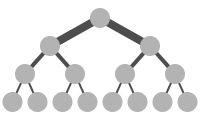
In August 2008, a group of computer scientists at UC San Diego published a scalable network architecture design that adopted a topology inspired by the fat-tree topology, achieving better scalability than previous hierarchical networks.
Advantages of Fat-Tree networks:
- Load balancing
- Low latency
Disadvantages of Fat-Tree networks:
- Scale is limited by the number of ports on the core switches
- Poor fault tolerance at the lower layers
- Does not adapt well to one-to-all and all-to-all communication patterns
2. Spine-Leaf
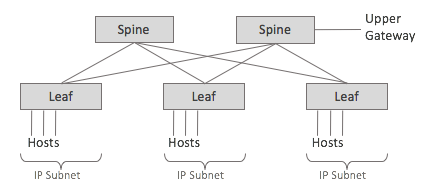
The Spine-Leaf network is a common data center network architecture. Unlike traditional hierarchical network structures, the Spine-Leaf network achieves a balanced topology at two levels: the Spine layer and the Leaf layer. Switches at the Leaf layer connect to servers, while switches at the Spine layer are responsible for connecting the Leaf-layer switches. Every Leaf switch connects to every Spine switch, thereby providing high-bandwidth and low-latency communication paths.
Advantages of Spine-Leaf networks:
- Good horizontal scalability: network capacity can be increased by adding more Spine and Leaf switches
- High reliability: multiple paths are supported, effectively avoiding single points of failure
- Low latency: equidistant multipath connections keep data transmission paths simple and stable
Disadvantages of Spine-Leaf networks:
- High cost: every Leaf switch must connect to all Spine switches, resulting in a large number of connections
- Complex configuration: the connections between switches must be carefully planned to maintain network symmetry
- Limited adaptability: in certain application scenarios the Leaf-layer connection scheme may need to be adjusted
3. Dragonfly
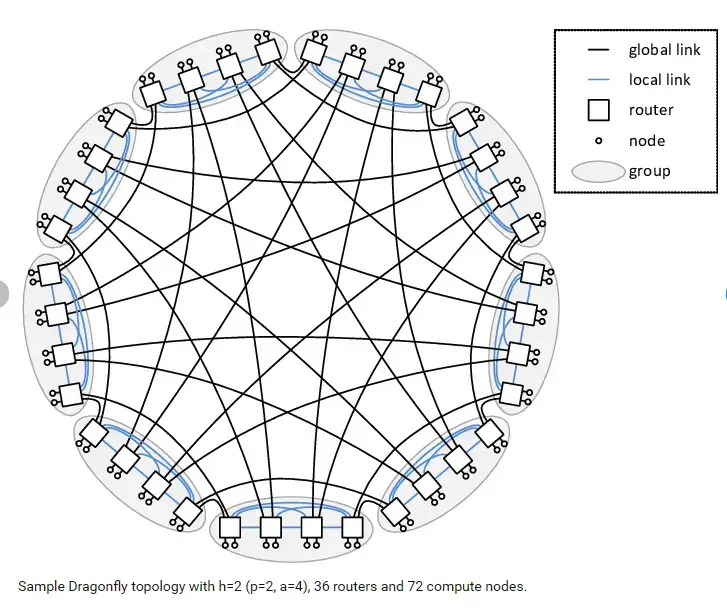
The Dragonfly network is an efficient network topology proposed by John Kim and others in 2008, first applied to high-performance computing (HPC) clusters. This structure mainly resolves the tension between bandwidth and cost in traditional fat-tree architectures, making it particularly suitable for large-scale parallel computing and data-intensive tasks. Through hierarchical switches and links, the Dragonfly network divides the network into multiple groups, each containing multiple routers or switches, with groups interconnected by relatively few inter-group links.
Advantages of Dragonfly networks:
- High bandwidth utilization: effective data transmission through local and global connections
- Small network diameter: fewer hops improve data transmission speed and reduce latency
- Low cost: efficient connection schemes reduce overall cabling and hardware costs
Disadvantages of Dragonfly networks:
- High routing complexity: global connections require relatively complex routing algorithms
- Average fault tolerance: a failure may affect a fairly wide range of connections
- Unsuitable for small-scale networks: in small deployments, the Dragonfly structure may lead to wasted resources
4. Torus
Torus (the ring network) is a topology commonly seen in high-performance computing (HPC) and distributed systems, first proposed by computer scientists in the 1980s and applied to parallel computing architectures.
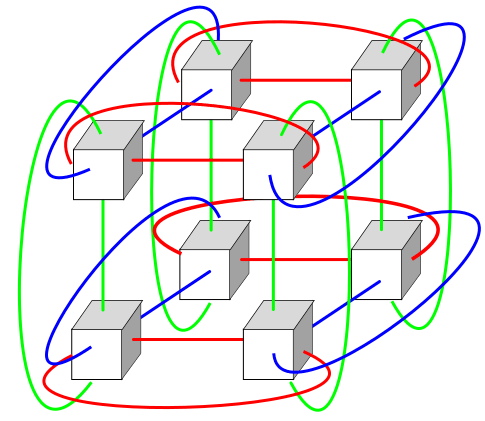
The Torus network is a multi-dimensional mesh structure in which boundary nodes form a closed loop through extra connections, making the connections of each node more symmetric.
Advantages of Torus networks
- Good load balancing: nodes are evenly connected, effectively spreading the communication load
- Low network latency: thanks to the closed-loop connections, the distance from each node to any other is short, so communication latency is low
- High fault tolerance: multipath connections let the network maintain communication despite a single point of failure
Disadvantages of Torus networks
- Limited scalability: in high-dimensional cases, the mesh boundary and node count grow substantially, increasing hardware complexity
- Complex cabling: especially in three dimensions and higher, cabling and node connections become difficult
- Unsuitable for broadcast communication: for one-to-all and all-to-all communication patterns, the Torus topology performs poorly and broadcast efficiency is low
