English title: The Black Swan
Subtitle: How to Deal with an Unpredictable Future
Author: Nassim Nicholas Taleb
Translator: Wan Dan
Publisher: CITIC Press
Publication Year: 2009-8
ISBN: 9787508616018
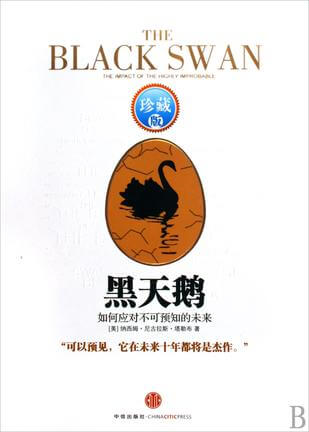
Notes:
The author uses his own experiences — the Lebanese war, a journalist’s war diary, a stock market crash, Yevgenia’s book — as his entry points, describing from personal experience this world that lives in uncertainty.
What you do not know is more meaningful than what you do know. Almost everything in social life is produced by rare but consequential shocks and jumps.
Our world is dominated by the extreme, the unknown, and the very improbable, yet we keep spending our time discussing trivial matters, focusing only on what is known and what happens repeatedly.
At the same time, a warning.
Three flaws in human thinking: the illusion of understanding, the retrospective distortion, and the overvaluation of factual information.
Most of what we credit to skill is merely an explanation after the fact.
Mistakenly treating a single naive observation of the past as something certain, or as representative of the future, is the only reason we fail to grasp the black swan phenomenon.
We usually take risks not out of confidence, but out of ignorance and blindness to uncertainty.
We are extremely arrogant about the knowledge we believe we possess.
The author also puts forward two concepts: Mediocristan and Extremistan. Mediocristan covers events unaffected by black swan events, while low-probability black swan events directly determine the outcome in Extremistan.
The author believes people’s biggest cognitive problem is treating all events as Mediocristan. But reality does not always conform to Mediocristan, and the Gaussian distribution so often cited in textbooks does not always match the facts either.
People are bound by idealized formulas, imagining that everything can be estimated and that risk is controllable. Reality often proves them wrong. We need to keep a critical spirit.
