1. My Experience Building Platforms
After graduation I joined Tencent BlueKing, mainly working on SaaS development. After nearly three years there, I went back to my hometown of Wuhan and joined QingCloud, where I was responsible for DevOps R&D. After nearly two years, I joined a new company, took part in building a business support platform, and thought about how the business side puts Kubernetes into practice.
I have written many documents about platforms — Domain Output Is the Core Competitiveness of PaaS , ToB Thinking of Large and Small Companies , The DevOps Platform Under Cloud Native , The Open Source Road of a ToB Startup - KubeSphere , How Enterprises Build ToB Products , and more. These are all thoughts my work has brought me.
Some things I have come across recently gave me the idea to write another document about BlueKing. In Wuhan there are not many internet companies with over a thousand people; Douyu and Kingsoft Office are among the standouts. But they have both successively given up on BlueKing. This puzzles me — BlueKing is the starting point of my thinking about platform building. Although I have left BlueKing and also left KubeSphere, I hope as always that these two products will be accepted and used by more and more people. Partly for emotional reasons, and partly because they are genuinely excellent. These are two very different products, with a great deal to commend them.
2. The Core Value of BlueKing
2.1 Tool Culture
BlueKing advocates a tool culture: liberate operations, and unlock the value of operations.
My understanding of tool culture has three levels:
- Skills become documentation. A skill should not be bound to a person; it should be reproducible. Writing experience and practice into documents is a low-cost way to accumulate and spread it.
- Documentation becomes tooling. No document, however good, is as direct as a script. Turning skill documentation into one-click scripts raises the output of a skill to another level.
- Tooling becomes a product. Tools carry too many domain concepts and complex runtime environments. A product lowers the barrier to use and delivers value better.
With this mindset, whether you are building a team or building a platform, you get twice the result for half the effort. But BlueKing’s value goes beyond this.
2.2 Straight to the PaaS Pyramid
Take operations systems as an example; let us build a platform together. Other scenarios are similar.
- Stage One
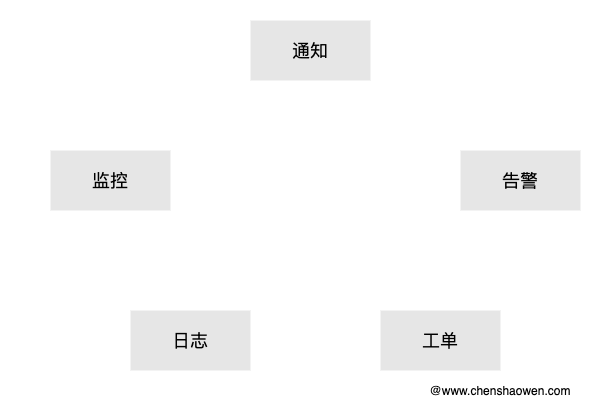
At first everything is waiting to be built; you adopt whatever off-the-shelf thing you can find and build your own when you cannot. Monitoring, alerting, logging, CICD, notifications each fight their own battle to solve business needs. Hence the topology below.
- Stage Two
Over time, isolated information sources can no longer bring the business more marginal value, and the barriers between systems block the building of IT infrastructure. So we connect the related systems and have them call one another. Thus the topology below.
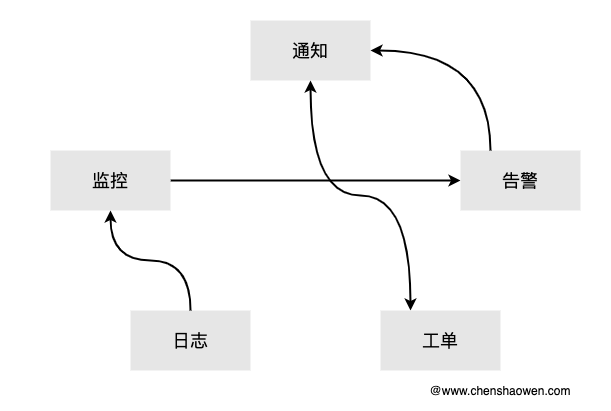
Many platforms end up stuck at the second stage, because N systems produce N *(N -1) connections, and they no longer have the energy for anything else.
- Stage Three
Below is the new topology.
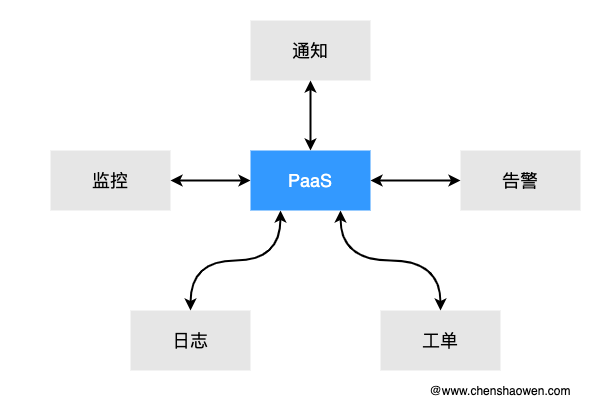
All systems should connect to the PaaS, which standardizes the calls between systems. This reduces the complexity of the problem from N squared to N .
Systems are autonomous internally and can change freely, but externally they must provide a unified API for other systems to consume. They also need companion SDKs, CLIs, and other tools to lower the barrier to use.
BlueKing goes straight to the third stage, skipping the rough and primitive first stage and the trap-filled second stage.
2.3 Domain Migration
Although BlueKing targets the operations industry, it has strong migration capability.
The figure below is an abstraction of BlueKing’s architecture.
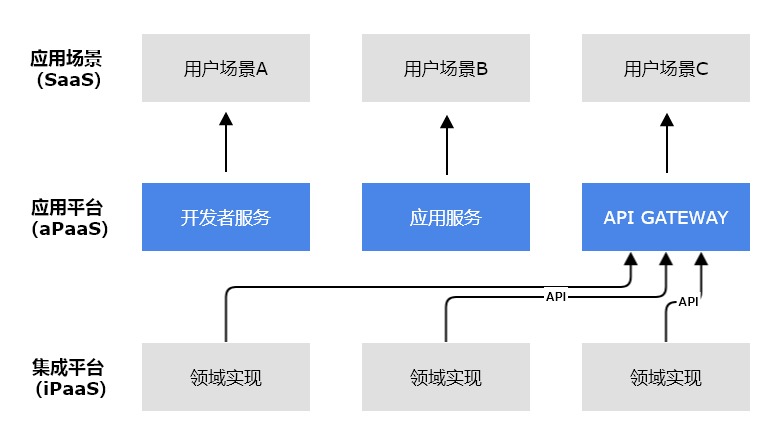
I first encountered aPaaS and iPaaS in Gartner’s Magic Quadrant, but I saw them truly implemented in BlueKing. aPaaS mainly hosts applications, so services can be operations-free; iPaaS mainly aggregates APIs and provides standardized interfaces to other applications.
For the operations domain, BlueKing has implemented the Job Platform, the Configuration Platform, and more. Whatever functionality the business needs, as long as the operations-domain implementations are stable, BlueKing lets R&D deliver SaaS quickly. If you have followed BlueKing’s public courses or the BlueKing developer certification exam, you will have some idea: building a SaaS takes only a few hours.
So if you migrate BlueKing to a non-operations domain, you really only need to fill in the domain implementations for iPaaS. In e-commerce, for example, you would fill in payment, logistics, orders, review management, and so on.
3. Obstacles You Will Meet When Using BlueKing
3.1 Partially Open-Source Code
Many potential customers come to BlueKing because of the large batch of useful, free SaaS. It is like a starving man drawn to a graceful figure. On closer look he finds blemishes — some SaaS is not open source — and, somewhat embarrassed into anger, he overlooks the inner beauty.
Open Core is a very common open-source strategy. Open-source the PaaS platform while keeping most of the SaaS closed — that is exactly the strategy BlueKing adopts.
The PaaS is the core of BlueKing’s value; just use the SaaS as third-party closed-source systems. Even if the SaaS were open source, not every engineer could change it. The SaaS BlueKing has already open-sourced includes Standard Ops, Blue Shield, and the Container Management Platform, but getting involved is not an easy matter either.
3.2 The Pride of Engineers
A proud engineer shows confidence in existing systems and rejects outside ones.
When investigating BlueKing, engineers should keep an empty-cup mindset: read the official docs more, get hands-on more, do not dismiss what you do not understand, and communicate more with the community.
Deploying, operating, and using BlueKing for the first time will certainly bring all kinds of problems. Studying a product and solving problems is itself a process of learning and growth; BlueKing is a huge product system and will differ from the platforms you have touched before. Engineers need a bit more patience to understand BlueKing’s design.
BlueKing started in 2012 and released its community edition in 2016; that it has kept growing over so many years surely has its reasons. Engineers should have confidence in the BlueKing product itself.
3.3 The Service Is Too Expensive
IT ToB companies have thought through many demand scenarios of ordinary companies.
- Outsourcing. They do not want to invest in R&D long term.
- Operations. They do not want to deploy and operate products.
- Compliance. They are at a loss over security issues.
- Training. They are slow to pick up new things.
- Consulting. They get stuck on hard technical problems.
- Customization. They want personalized changes.
…
The space these ToB companies survive in comes from the fact that hiring engineers is too expensive for customers. Having a ToB company provide backstop services for non-core business fits the collaborative model of the social division of labor: give the right job to the right people.
There are many service providers around BlueKing. Whether the BlueKing Enterprise Edition service is expensive depends on how much cost BlueKing saves and how much it costs to maintain it yourself. An operations system is never built in one step; it is a process of continuous evolution and improvement, and you have to assess it yourself.
From another angle, compared with other open-source products, if there is no SLA service provider, then money cannot solve the problem at all — and that is the real problem. At least with BlueKing’s problems, money can still solve them.
3.4 Migration Costs Are Too High
For a company that already has some IT infrastructure, using BlueKing means giving up its own CMDB and other systems. That seems somewhat unacceptable.
But as I have repeatedly stressed, BlueKing’s core is the PaaS; the underlying domain implementations can be replaced. You only need to connect to the iPaaS so that upper-layer systems can consume it.
Another option is to treat BlueKing as a third-party system, build your own PaaS, and connect BlueKing into your own iPaaS. Even if you conquer it by force, in the end you will be assimilated. BlueKing is a product worth cherishing. Wonderful!
